

MCAS and POTS: 4 Steps to Break the Histamine-Stress Cycle
The two-way street most doctors are missing, and why treating only one side fails.
What Is This?
Mast cells are immune cells that live in your tissues — your skin, your gut, your lungs, your blood vessels. When triggered, they release histamine and other chemicals. Histamine is normal and necessary. It helps regulate stomach acid, sleep, blood pressure, and inflammation. But when your body releases it too easily, or can’t break it down fast enough, it builds up.
Meanwhile, your autonomic nervous system (ANS) runs everything you don’t think about. ANS handles heart rate, blood pressure, digestion, sweating, temperature. Most people have never heard of it, but it’s the control panel for your whole body.
Here’s the problem: these two systems are connected, and a disorder in one may affect the other. If you have mast cell activation syndrome (MCAS), then you likely also have some degree of dysautonomia (autonomic dysfunction). The opposite is also true. If you have dysautonomia, then it is probable you have MCAS. Most doctors treat only one problem in patients and never the other. That’s a major blind spot in modern medicine.
The core message of this article: MCAS and autonomic dysfunction is a two-way street. Histamine drives autonomic chaos. Autonomic chaos makes mast cells release more histamine. Most often, treating both will break the cycle.
The treatment is the test. The treatment response is a clue. If lowering histamine and calming your nervous system leads to rapid symptom improvement, it may offer an important clue about what’s contributing to your symptoms.
First, Meet Your Two Key Players
The Mast Cell
Normally, mast cells are protective. They’re part of your body’s first line of defense against invaders. In MCAS, they’re trigger-happy, firing off histamine at the wrong times.
The Autonomic Nervous System
It has two branches that work like a gas pedal and a brake:
| Branch | Job | Dominant When |
| Sympathetic (“fight or flight”) | Speeds up the heart, raises blood pressure, dilates airways, slows digestion | Stress, danger, standing up |
| Parasympathetic (“rest and digest”) | Slows down the heart, lowers blood pressure, promotes digestion, sleep | Rest, calm |
The vagus nerve is your main “brake.” It is the parasympathetic highway that calms everything down, including your mast cells. When vagal tone is high, mast cells stay calm. When it is low, mast cells get trigger-happy. The key is balance between these two systems.
The Two-Way Street: How MCAS Drives Autonomic Dysfunction
This is direction #1 and it’s one possible reason some MCAS patients develop POTS.
Histamine does two things that directly scramble your autonomic nervous system:
- It dilates blood vessels (a potent vasodilator via H1/H2 receptors). Blood vessels relax, widen, and blood pools in your extremities.
- It increases norepinephrine and adrenaline, a direct sympathetic stimulant.
Now put those together. This is the recipe for POTS (postural orthostatic tachycardia syndrome), the most classic dysautonomia:
Histamine dump → blood vessels dilate → blood pools in legs → brain senses dropping blood pressure → sympathetic system screams “emergency!” → heart rate spikes to compensate.
That’s why MCAS patients so commonly have POTS. It is NOT a coincidence. The histamine load itself is causing the autonomic chaos. It’s also why you get:
- Palpitations, racing heart
- Orthostatic hypotension (sudden blood pressure drops on standing)
- Anxiety, “fight or flight” feelings (from adrenaline)
- Flushing, sweating, temperature dysregulation
- Digestive slowdown or IBS-type symptoms (sympathetic dominance suppresses normal gut function)
In short, histamine directly revs up the sympathetic system and sabotages the parasympathetic brake.
And the Reverse: How Autonomic Dysfunction Worsens MCAS
This is direction #2 and it’s the part almost everyone misses.
The vagus nerve doesn’t just calm your body down. It actively regulates mast cell activity.
- High vagal tone = stable, calm mast cells.
- Low vagal tone = reactive, easily triggered mast cells that release more histamine.
Cortisol (the stress hormone) makes it worse still. Cortisol reduces DAO enzyme function and increases histamine release from mast cells.
So, the cycle feeds itself:
Chronic stress / chronic sympathetic overdrive → low vagal tone → mast cells fire more easily → more histamine → more vasodilation, more adrenaline → more sympathetic overdrive → more vagal suppression → more histamine…
This is why “a stressful event brought it all out.” Patients repeatedly report this pattern. And it’s why so much of the dysfunction in MCAS is not just about food. Your nervous system state is a trigger, a driver, and a victim all at once.
The Vicious Cycle (The Whole Picture)
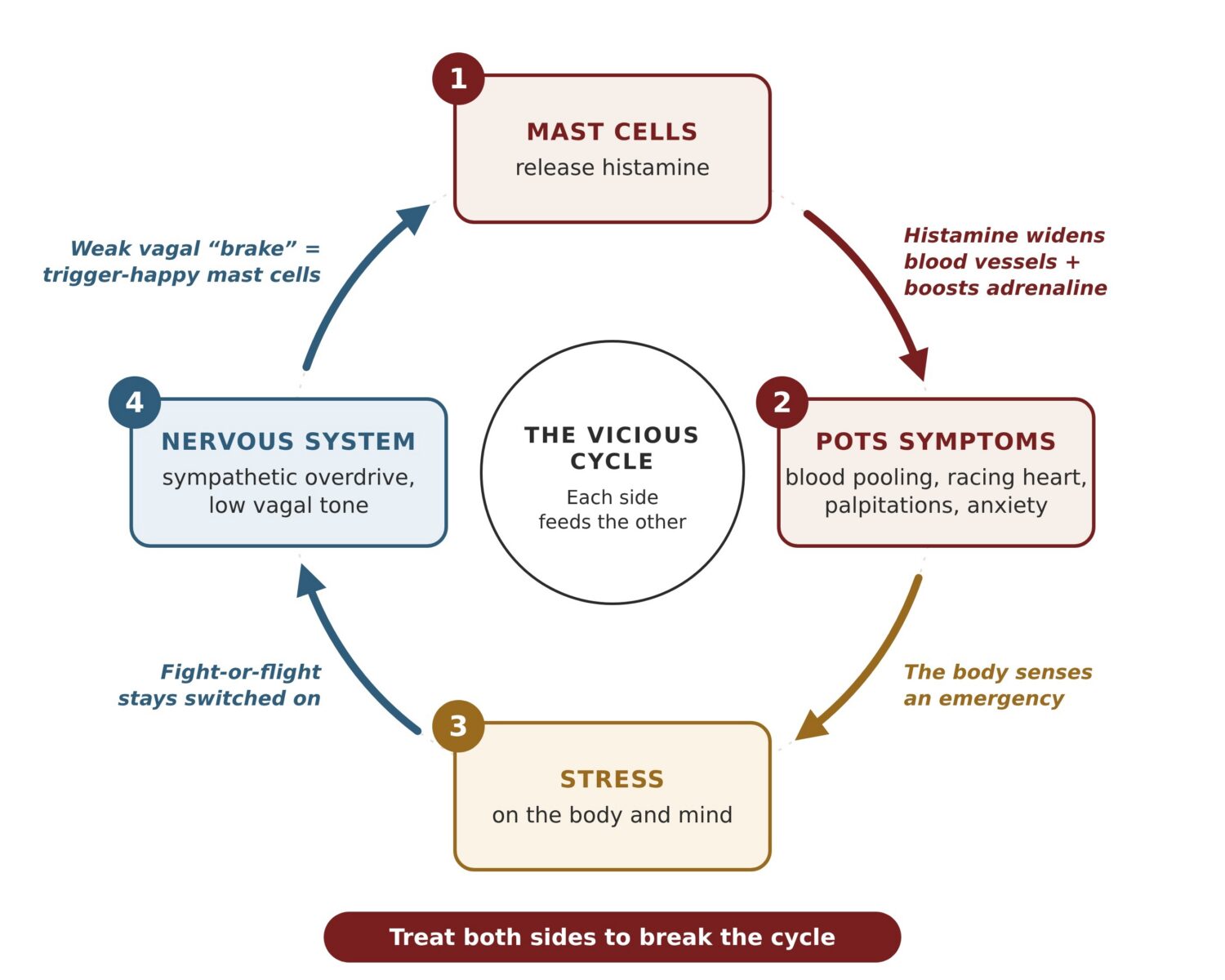
Each side feeds the other. Histamine causes autonomic dysfunction. Autonomic dysfunction causes histamine release. Untreated, it spirals.
Why Most Treatment Fails (The Blind Spot)
Here’s the problem I see repeatedly:
- The cardiologist or neurologist treats POTS with beta blockers, salt, compression, and hydration, but may never look at mast cells. The histamine keeps dumping; the POTS keeps coming back.
- The allergist treats MCAS with antihistamines, mast cell stabilizers, and diet, but may never look at the nervous system. The patient keeps living in chronic sympathetic overdrive; the mast cells stay revved up.
Each treat only half the loop. Neither breaks the cycle.
The patients who genuinely improve are the ones whose care addresses both sides simultaneously: low-histamine diet + mast cell stabilization and nervous system.
What You Can Do: Treating Both Sides
The Histamine Diet Is Essential
There’s no way to remove histamine entirely from your diet. But you can avoid foods that are high in histamine and foods that cause your body to release histamine. Lists vary and contradict each other, because each person is different. Eggs appear on “avoid” lists for some and “eat” lists for others. Here’s why. Egg whites don’t contain much histamine, but they trigger histamine release in some.
The most important concept: histamine’s effects are cumulative.
If you tolerate avocados but add sauerkraut at the same meal, you may have a reaction. But not because you’re “allergic” to either. It is because the combination overwhelmed your enzymes. It becomes a threshold problem, not an allergy. The same applies during pollen season. Add a normally fine high-histamine food while mid-allergy-reaction, and you tip over the edge. It’s all additive.
A food diary is essential. Research shows a strict low-histamine diet helps your enzymes function better over time, so be disciplined early. Once symptoms resolve, add foods back one at a time.
(I’m not reproducing a food list here because there are many good ones. The UK NHS has a clear patient handout on the low-histamine diet.)
Supplements That Help (the histamine side)
| Supplement | What It Does | Suggested Use* |
| DAO (Diamine oxidase) | (Replaces the digestive enzyme that breaks down histamine in the gut | 1 capsule (10,000 units) with each meal, <15 min before eating |
| Copper | Essential for DAO to function | 2 mg/day short-term; involve your doctor (copper and zinc compete) |
| SAMe | Donates the methyl group HNMT needs to deactivate histamine | ~400 mg/day |
| Quercetin | Stabilizes mast cells — prevents them from releasing excess histamine | ~500–1000 mg/day; consider with bromelain for absorption |
*Doses are examples, not a prescription — please confirm with your own clinician.
Important caveat on DAO supplements: they work in the gut to break down histamine before it’s absorbed. Once histamine is in your bloodstream, a DAO supplement can’t help. That’s why the diet remains non-negotiable even with supplements.
Calming the Nervous System (This is the half most treatment plans ignore)
- Sleep. Sleep is non-negotiable. Histamine prevents sleep, which is why Benadryl works. Poor sleep raises sympathetic tone, which revs up mast cells. Sleep is not optional for MCAS patients; it’s treatment.
- Stress reduction / vagal tone. Do breathing exercises, gentle movement or whatever reliably calms you. High vagal tone = calmer mast cells. This is physiology, not “relaxation woo.”
- Treat the POTS directly. Hydration, increased salt intake when medically appropriate, and compression garments can help reduce blood pooling and improve circulation. These measures may ease the strain on the autonomic nervous system, which interacts with mast cell activity. If your doctor prescribes medication for POTS (e.g., beta blockers), that’s part of breaking the loop, too.
- Avoid sympathetic triggers. Avoid excessive caffeine, alcohol, overexertion, and chronic stress. They all push your nervous system toward the “fight or flight” state that destabilizes mast cells.
Medications (these are available OTC at any pharmacy)
- Cimetidine (Tagamet). Cimetidin blocks histamine in the stomach, reducing acid. It is useful for ulcer-related symptoms and doesn’t lower histamine levels. This drug blocks a receptor. Tagamet interacts with other drugs like warfarin and theophylline. I recommend doctor oversight.
- Diphenhydramine (Benadryl, Tylenol PM). Blocks histamine receptors throughout the body, and because it reaches the brain, it causes drowsiness, which can aid sleep. Like all antihistamines, it doesn’t lower your histamine level. It blocks histamine’s signal, so the underlying load is still there. Good for occasional, short-term use only.
The Bottom Line
MCAS and autonomic dysfunction form a single cycle and should be treated together.
The cycle will keep spinning if your doctor treats your POTS but not your mast cells. It will also continue to wreak havoc if your doctor treats your MCAS but not your nervous system.
Here’s your practical starting plan to break the loop:
- Try a strict low-histamine diet for two weeks with a food diary.
- Take DAO with meals to support gut breakdown.
- Calm your nervous system daily. Focus on prioritizing sleep, breathing, and stress reduction. Treat it as seriously as the diet.
- Track your symptoms. Most people notice a difference within days if histamine is driving the picture.
Look at everything. The supplements may be helpful, but the diet is essential. And so is calming the nervous system. Treat both, or the cycle never breaks.



Featured Sponsor



Latest Home Cures That Work Issue
If you are a member of Home Cures That Work, click on the image above to download your monthly issue in PDF format.