

8 Natural Ways to Boost Your Own GLP-1 (Without a Single Injection)
Peptide hormones are both awesome and terrible at the same time. When people figured-out what GLP-1 did in the body, they found a way to market it. Let me first show you how wonderful they are:
GLP-1 receptors (GLP-1R) are far more widely distributed than most people expect, which is exactly why the hormone (and the drugs) has effects well beyond appetite. The main sites, grouped by where they matter:
Pancreas — Releases more insulin, lowers blood glucose, and blocks glucagon so the liver doesn’t make extra glucose. Net effect: lower glucose.
Brain and brainstem — This is the part where people feel full. They say, “I’m not hungry all the time!” or “I don’t have that ‘food noise’ in my head!” so they no longer crave food.
Vagus nerve / peripheral sensory neurons — This is the direct connection between the brain and the digestive tract. Net effect: Not hungry
Stomach and GI tract — This is the biggest part that slows the stomach from emptying so you don’t get hungry after a meal.
Heart and blood vessels — The blood pressure goes down; blood vessels dilate more. Net effect: less heart disease.
Kidney — GLP-1 helps the kidneys get rid of sodium more easily, lowers blood pressure.
Lung — helps the airways be open to get more air.
Bone — Increases bone growth by stimulating osteoblasts to build bone, releasing calcitonin, and inhibiting bone reabsorption. Net effect: stronger bones
So, you want this peptide hormone to do all these good things for your body. The question is, how to get it, and make it work right. Part of the problem is that once the blood excretes this peptide, it lasts only a few minutes, and it’s gone. DPP-4 chews up the enzyme rather quickly in the blood. So it must be continuously secreted to maintain a level.
So, now we have a “solution.” There are GLP-1 receptor agonists that act like GLP-1, but they last for a week instead of a minute. Perfect! But, not so fast, there is trouble in paradise!
The Problems with GLP-1 Agonist Injections
Giving injections to people is NOT the same as having natural GLP-1 in the body.
These drugs are not broken down the way natural GLP-1 is. GLP-1 drugs are a chemical bypass that lets people continue eating garbage while artificially suppressing the consequences, at least temporarily. They don’t fix insulin resistance at the cellular level. They paper over it. Look at the following graph. The orange is what an injection looks like in a whole day, and the blue is what a normal GLP-1 looks like.
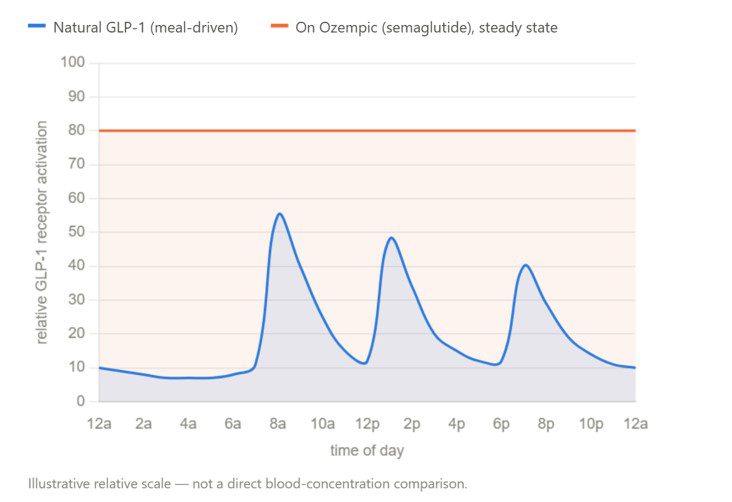
The half-life of active GLP-1 is only 1–2 minutes. The enzyme DPP-4 chops it up almost immediately, which is why the natural curve is a series of modest, short-lived bumps rather than a plateau. This ON—OFF variation allows natural GLP-1 to keep your body working well in all the ways we discussed above. However, these engineered drugs resist DPP-4 and last days instead of minutes, creating the problem of always being on. GLP-1 agonists — Ozempic, Wegovy, Mounjaro, Zepbound — are pushed as miracle drugs. But the reality is far more concerning, and the long-term picture is essentially a massive uncontrolled experiment on millions of people.
What They Actually Do
These drugs bind to GLP1 receptors continuously, causing:
- Delayed gastric emptying — Your stomach doesn’t empty, which could become a permanent problem leading to gastroparesis and chronic nausea in some people.[1]
- Appetite suppression isn’t selective. People stop wanting not just junk food but all food, including nutrient-dense whole foods their bodies desperately need.
- The weight loss is partly muscle and bone, not just fat. Studies show a significant portion of weight lost on GLP-1s is lean body mass — 25-40%[2].
- Thyroid tumors were found in rats given GLP-1 injections.[3] This may not translate to humans, but we may not know for years.
- Pancreatitis and Pancreatic Cancer — There are documented cases of acute pancreatitis, some fatal. [4] Pancreatic cancer also shows up on the FDA surveillance. Some say it is because they already had cancer, but, again, the long-term is unknown.[5]
- Muscle Wasting and Metabolic Damage – Higher insulin and rapid weight loss cause the body to use protein instead of fat. When people stop the drug (and most do within a year), they regain fat — but not muscle.[6]
- Mental Health — Suicidal ideation, anxiety, depression are associated with these medications.[7]
- Gallbladder Disease — Rapid weight loss + bile stasis from slowed emptying = gallstones, cholecystitis, gallbladder removal. It’s so common it’s almost expected.[8]
How to do it right
Your body makes GLP-1 mainly in the L-cells of your gut, released in response to what you eat and how you live. Take a look at two different diets, one has protein, fat, and fiber, the other is processed carbohydrates with little fiber.
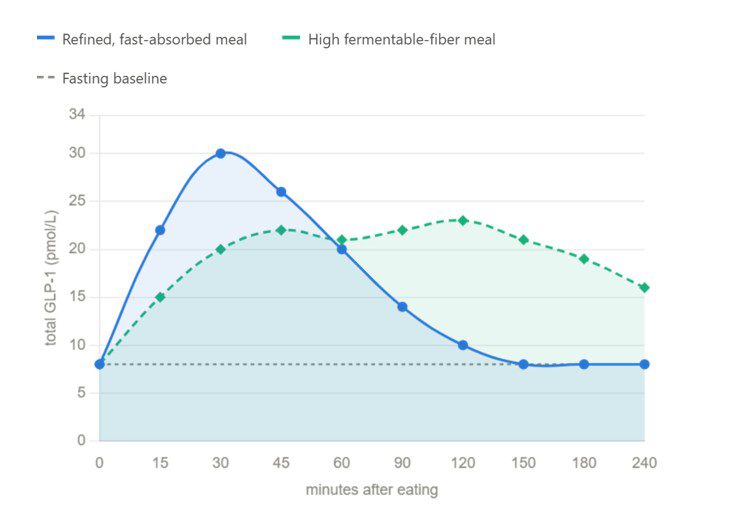
The dashed gray line is fasting baseline (~8 pmol/L).
The refined meal (blue) gives a taller, earlier spike. That’s the fast neural/hormonal phase plus quick absorption high in the gut, but it collapses back to baseline within about 2 hours.
The high-fiber meal (green, dashed) initially peaks lower but holds a broad plateau for hours. This is because bacterial fermentation in the distal gut keeps generating short-chain fatty acids that stimulate the dense ileal and colonic L-cells long after the meal.
Real food that is not processed allows you to make GLP-1 for longer periods, so you get all the benefits without any of the risks. Processed food prevents us from getting the benefits of GLP-1!
Now, here’s how to get all the benefits from GLP-1 made in your own body, the right way:
- Feed your gut bacteria fermentable fiber. This is the strongest natural lever. Gut microbes turn soluble and fermentable fiber into short-chain fatty acids (butyrate, propionate), and those directly trigger GLP-1 release. Best sources: legumes (beans, lentils, chickpeas), oats and barley, onions, garlic, leeks, asparagus, unripe/green bananas, and cooled cooked potatoes or rice (resistant starch). Concentrated options are inulin and psyllium.
- Front-load protein and healthy fat at meals. Both stimulate GLP-1 directly. Include a solid protein source and monounsaturated fats (olive oil, avocado, nuts) and omega-3s (fatty fish) at meals rather than carb-heavy, low-fat meals.
- Avoid processed carbohydrates. White bread, pasta, white rice, and processed sugars do not release GLP-1.
- Sequence your meals. Eating vegetables and protein before the starch/carb portion of a meal raises the GLP-1 response and blunts the glucose spike. Same food, better hormonal response.
- Exercise, especially after eating. Both aerobic and resistance exercise increase GLP-1. Even a 10–15 minute walk after meals helps.
- Add bitter foods and polyphenols. Bitter compounds (arugula, dandelion greens, bitter melon) activate gut bitter receptors that stimulate GLP-1. Polyphenols from berries, green tea, coffee, olive oil, and cocoa support the same pathway and your microbiome.
- Support the microbiome broadly. Fermented foods (yogurt, kefir, kimchi, sauerkraut) and a wide variety of plants build the bacterial populations that produce the SCFAs driving GLP-1.
- Protect sleep and manage stress. Poor sleep and chronic stress blunt satiety signaling, including GLP-1. And cut ultra-processed foods and refined sugar, which work against all of the above.
A realistic expectation: this raises and sustains your baseline GLP-1 tone rather than producing the sharp, sustained pharmacologic effect of the medications. The metabolic and appetite benefits are real, just more gradual. Because the ON-OFF switch is working daily, you get the benefits of GLP-1 without the risks of the drugs.
Sources:
[1] https://telehealthally.com/guides/glp1-gastroparesis-gi-risk-guide
[2][2] https://www.weightlossrankings.org/research/ozempic-muscle-loss-lean-mass-protection-evidence
[3] https://pmc.ncbi.nlm.nih.gov/articles/PMC3281535/
[4] https://www.bmj.com/content/392/bmj.s204
[5] https://link.springer.com/article/10.1007/s11096-023-01556-2
[6] https://harvardsciencereview.org/2026/02/23/the-glp-1-aftermath-what-the-science-says-about-muscle-loss-and-cellular-aging/
[7] https://www.mdpi.com/1424-8247/19/6/953
[8] https://jamanetwork.com/journals/jamainternalmedicine/fullarticle/2790392




Featured Sponsor





Latest Home Cures That Work Issue

If you are a member of Home Cures That Work, click on the image above to download your monthly issue in PDF format.